I was happy to read in the Dallas Morning News, Sunday May 27, 2012, an interview with Talmage Boston. He has written a book, "Raising the Bar: The Crucial Role of the Lawyer in Society," that seeks to provide a blueprint for how lawyers can and should contribute to society. When I proposed the Cicero Project, I suggested developing in Texas the most capable lawyers in the world. Mr. Boston's book is a positive step in that direction.
Robert Canright
Here is a link to the Cicero Project
Sunday, May 27, 2012

Sunday, May 13, 2012
On Modeling
Misused financial models contributed to the economic melt-down on Wall Street, leading to the Great Recession. Financial firms wagered fortunes on mathematical models they did not understand. Here is an excellent thought on modeling.
The art of model-building is the exclusion of real but irrelevant parts of the problem, and entails hazards for the builder and the reader. The builder may leave out something genuinely relevant; the reader, armed with too sophisticated an experimental probe or too accurate a computation, may take literally a schematized model whose main aim is to be a demonstration of possibility.
From physicist Philip Anderson's 1977 Nobel Prize acceptance speech, as quoted in Complexity, A Guided Tour by Melanie Mitchell. (page 224).
Mathematical modeling is easily misused, but it is important for working with complex systems. Mathematical modeling must be a part of our growth as an economic power.
Robert
The art of model-building is the exclusion of real but irrelevant parts of the problem, and entails hazards for the builder and the reader. The builder may leave out something genuinely relevant; the reader, armed with too sophisticated an experimental probe or too accurate a computation, may take literally a schematized model whose main aim is to be a demonstration of possibility.
From physicist Philip Anderson's 1977 Nobel Prize acceptance speech, as quoted in Complexity, A Guided Tour by Melanie Mitchell. (page 224).
Mathematical modeling is easily misused, but it is important for working with complex systems. Mathematical modeling must be a part of our growth as an economic power.
Robert
Military Research Drives Economic Growth
Some people believe military spending should be cut so more money could be spent taking care of the poor. The classic textbook Economics by Paul Samuelson has a chart of "guns versus butter" as an example of economic tradeoffs. This is a deceptive argument.
Military research created the dynamos that drive the modern economy: computers, computer programming, the internet, radar, and jet aircraft. Let us look briefly at computers, using the MANIAC computer as an example. MANIAC stands for mathematical and numerical integrator and computer. It was the brain child of John von Neumann while he was at the Institute for Advanced Study at Princeton. We all know how computers drive the modern economy. However, the first test of the MANIAC happened in the summer of 1951, and it was a thermonuclear calculation that ran for 60 days nonstop.
As we give more thought to economics, we must avoid being misled by spurious arguments. A strong military is indispensable for a free nation. Military research often leads to economic growth. Are Texas universities contributing enough to America's military research?
Robert Canright
Information about the MANIAC computer is from the book, Turing’s Cathedral, the Origins of the Digital Universe, by George Dyson
Military research created the dynamos that drive the modern economy: computers, computer programming, the internet, radar, and jet aircraft. Let us look briefly at computers, using the MANIAC computer as an example. MANIAC stands for mathematical and numerical integrator and computer. It was the brain child of John von Neumann while he was at the Institute for Advanced Study at Princeton. We all know how computers drive the modern economy. However, the first test of the MANIAC happened in the summer of 1951, and it was a thermonuclear calculation that ran for 60 days nonstop.
As we give more thought to economics, we must avoid being misled by spurious arguments. A strong military is indispensable for a free nation. Military research often leads to economic growth. Are Texas universities contributing enough to America's military research?
Robert Canright
Information about the MANIAC computer is from the book, Turing’s Cathedral, the Origins of the Digital Universe, by George Dyson
Tuesday, April 10, 2012
TBAR: The Economics Project Defined
The Texas Ascendant Campaign is a plan to save America by building a stronger Texas. Many of America's leaders come from the North East. Texans need to step forward to help lead America.
Texans have been in the White House during a number of modern crises. Lyndon B. Johnson was President during the Vietnam War. George H.W. Bush was President during the Gulf War. George W. Bush was President during 9-11. Some day in the future a Texan might be President during a make-or-break period in our future, and we need the best prepared person with the best supporting people from the great state of Texas to ensure our county's success.
The Texas Ascendant Economics Project is a plan to develop the best thinking about economics, a plan to develop world class economics experts in Texas, a plan to raise the education level about economics, and a plan to use economics to build a stronger Texas and a stronger America.
Here is a list of articles related to the Economics Project:
How to Win a Nobel Prize in Economics (Part 1): Economic Growth without Growth August 23, 2008
The Economics Project, Economic Warfare and the Texas 4x4 Wednesday, February 18, 2009
The Texas Economics Project, Part 2 Saturday, February 21, 2009
The Billionaire Project and the Texas 4x4 Saturday, February 7, 2009
Economic Growth Without Population Increase Sunday, April 8, 2012
Military Research Drives Economic Growth Sunday, May 13, 2012
On Modeling Sunday, May 13, 2012
Pitfall in the Path to Unlimited Growth Sunday, December 2, 2012
Fed Policy is a Drag on the Economy Thursday, February 14, 2013
Texans have been in the White House during a number of modern crises. Lyndon B. Johnson was President during the Vietnam War. George H.W. Bush was President during the Gulf War. George W. Bush was President during 9-11. Some day in the future a Texan might be President during a make-or-break period in our future, and we need the best prepared person with the best supporting people from the great state of Texas to ensure our county's success.
The Texas Ascendant Economics Project is a plan to develop the best thinking about economics, a plan to develop world class economics experts in Texas, a plan to raise the education level about economics, and a plan to use economics to build a stronger Texas and a stronger America.
Here is a list of articles related to the Economics Project:
How to Win a Nobel Prize in Economics (Part 1): Economic Growth without Growth August 23, 2008
The Economics Project, Economic Warfare and the Texas 4x4 Wednesday, February 18, 2009
The Texas Economics Project, Part 2 Saturday, February 21, 2009
The Billionaire Project and the Texas 4x4 Saturday, February 7, 2009
Economic Growth Without Population Increase Sunday, April 8, 2012
Military Research Drives Economic Growth Sunday, May 13, 2012
On Modeling Sunday, May 13, 2012
Pitfall in the Path to Unlimited Growth Sunday, December 2, 2012
Fed Policy is a Drag on the Economy Thursday, February 14, 2013
Sunday, April 8, 2012
Economic Growth Without Population Increase
Growth Without Growth
The world's population is trying to stabilize. Population growth in some Western counties has stabilized at or slightly below replacement rates and this has been perceived as a problem because our economic models are all based on growing populations: more people means more sales.
A fundamental problem facing modern economics is to formulate a plan that enables infinite economic growth with a constant population. I first posed this problem back in 2008, but now I have a plan to suggest.
First, allow me to set the stage by asking, "how can a finite number of people produce and consume an infinite amount of goods and services?" The solution to this problem is found in software. Real people will control populations of simulated people (avatars, after a fashion) that produce and consume simulated goods and services. This scenario is already within the realm of possibility.
The real problem is not in creating a simulated economy. The problem is in moving simulated money from a simulated economy into the real world. There are already online simulation games (RPGs, role playing games) that allow players to move real money into a simulated world. But economic growth in a simulated economy creates money of dubious value: funny money. Moving large amounts of funny money into a real economy could debase real currency and create real inflation.
The Future is Upon Us
In truth, we already have elements of a simulated economy. Financiers call the instruments of a simulated economy "derivatives." And because banks create money through loans and limited capital reserves, to the extent that profits from derivatives are due to leverage (loans), much of the profits from derivatives are the same kind of funny money that a computer simulation would generate. This means that moving money from the derivatives market to the real economy of real goods and services has the potential to debase our currency and create inflation.
Consider a few numbers from The Ascent of Money: A Financial History of the World by Niall Ferguson. (If you do not have time to read the book, watch the PBS version.)
World economic output = $47 x10^12 (47 trillion dollars)
World stock and bond market = $119 x10^12 = 2.5 times world economic output
World derivatives market = $473 x10^12 = 10 times world economic output
If the world derivatives market were liquidated and the money used to buy goods and services, then the price of goods and services would skyrocket because too much money would be chasing too few goods. This would lead to inflation, perhaps hyperinflation. Warren Buffet has called derivatives "financial weapons of mass destruction." I suspect derivatives are even more dangerous than Mr. Buffet has indicated.
What Does This Mean to Us?
If Texans are to become world leaders in economics, it would be good for our economists to become increasingly proficient in programming, in simulations, in complexity theory, autonomous systems theory, game theory, and derivatives. We need to become leaders in both real economic growth and simulated growth because simulated growth might truly be a part of our future.
Additionally, you and I should demand that our elected representatives protect our currency. If the derivatives market is not controlled, it could destroy our life savings.
Robert Canright
This post is part of the Economics Project of the Texas Ascendant Campaign
The world's population is trying to stabilize. Population growth in some Western counties has stabilized at or slightly below replacement rates and this has been perceived as a problem because our economic models are all based on growing populations: more people means more sales.
A fundamental problem facing modern economics is to formulate a plan that enables infinite economic growth with a constant population. I first posed this problem back in 2008, but now I have a plan to suggest.
First, allow me to set the stage by asking, "how can a finite number of people produce and consume an infinite amount of goods and services?" The solution to this problem is found in software. Real people will control populations of simulated people (avatars, after a fashion) that produce and consume simulated goods and services. This scenario is already within the realm of possibility.
The real problem is not in creating a simulated economy. The problem is in moving simulated money from a simulated economy into the real world. There are already online simulation games (RPGs, role playing games) that allow players to move real money into a simulated world. But economic growth in a simulated economy creates money of dubious value: funny money. Moving large amounts of funny money into a real economy could debase real currency and create real inflation.
The Future is Upon Us
In truth, we already have elements of a simulated economy. Financiers call the instruments of a simulated economy "derivatives." And because banks create money through loans and limited capital reserves, to the extent that profits from derivatives are due to leverage (loans), much of the profits from derivatives are the same kind of funny money that a computer simulation would generate. This means that moving money from the derivatives market to the real economy of real goods and services has the potential to debase our currency and create inflation.
Consider a few numbers from The Ascent of Money: A Financial History of the World by Niall Ferguson. (If you do not have time to read the book, watch the PBS version.)
World economic output = $47 x10^12 (47 trillion dollars)
World stock and bond market = $119 x10^12 = 2.5 times world economic output
World derivatives market = $473 x10^12 = 10 times world economic output
If the world derivatives market were liquidated and the money used to buy goods and services, then the price of goods and services would skyrocket because too much money would be chasing too few goods. This would lead to inflation, perhaps hyperinflation. Warren Buffet has called derivatives "financial weapons of mass destruction." I suspect derivatives are even more dangerous than Mr. Buffet has indicated.
What Does This Mean to Us?
If Texans are to become world leaders in economics, it would be good for our economists to become increasingly proficient in programming, in simulations, in complexity theory, autonomous systems theory, game theory, and derivatives. We need to become leaders in both real economic growth and simulated growth because simulated growth might truly be a part of our future.
Additionally, you and I should demand that our elected representatives protect our currency. If the derivatives market is not controlled, it could destroy our life savings.
Robert Canright
This post is part of the Economics Project of the Texas Ascendant Campaign
Friday, December 23, 2011
TBAR: A Philosophy of Banking
An Op-Ed piece in the Wall Street Journal, Christmas Trees and the Logic of Growth by Mark Spitznagel (Dec. 12, 2011) compared the containment of bank failures to the containment of forest fires.
Mr. Spitznagel explained how 100 years ago the U.S. Forest Service set a policy of suppressing all forest fires. Enough dead wood had accumulated over the years that in 1988 a massive wildfire destroyed an area 30 times larger than any previous forest fire. The previous policy of containment was reversed and a new policy that recognizes the need to allow some forest fires to burn to restore a natural balance.
Mr. Spitznagel then compared the outdated fire containment policy of the U.S. Forest Service to Alan Greenspan's bailout of the Continental Illinois bank in 1988. This was the largest bank failure in U.S. history until the failure of Washington Mutual in 2008. There is an informative article about the Continental Illinois failure in Wikipedia and a detailed article (a chapter in a book) at the FDIC. His point is that refusing to admit the losses on the books of many banks is perpetuating a climate of low growth. He said that central banks create a tinderbox when keeping alive bad investments.
Before our banking debacle in 2008 I remember reading articles in the Wall Street Journal that criticized Japanese banks for refusing to admit many of their assets were worthless. Carrying bad loans on their books was keeping their economy depressed. It is easy to see fault in others.
A set of guiding principals about banking might be said to be a philosophy if those principals are formed rationally. But a set of guiding principals about banking could be called an ideology or self-deception if it is based on desires or political considerations that fly in the face of reason.
We need banking in Texas to be managed rationally.
Robert
This article is part of the Texas Banking an Finance Project
Mr. Spitznagel explained how 100 years ago the U.S. Forest Service set a policy of suppressing all forest fires. Enough dead wood had accumulated over the years that in 1988 a massive wildfire destroyed an area 30 times larger than any previous forest fire. The previous policy of containment was reversed and a new policy that recognizes the need to allow some forest fires to burn to restore a natural balance.
Mr. Spitznagel then compared the outdated fire containment policy of the U.S. Forest Service to Alan Greenspan's bailout of the Continental Illinois bank in 1988. This was the largest bank failure in U.S. history until the failure of Washington Mutual in 2008. There is an informative article about the Continental Illinois failure in Wikipedia and a detailed article (a chapter in a book) at the FDIC. His point is that refusing to admit the losses on the books of many banks is perpetuating a climate of low growth. He said that central banks create a tinderbox when keeping alive bad investments.
Before our banking debacle in 2008 I remember reading articles in the Wall Street Journal that criticized Japanese banks for refusing to admit many of their assets were worthless. Carrying bad loans on their books was keeping their economy depressed. It is easy to see fault in others.
A set of guiding principals about banking might be said to be a philosophy if those principals are formed rationally. But a set of guiding principals about banking could be called an ideology or self-deception if it is based on desires or political considerations that fly in the face of reason.
We need banking in Texas to be managed rationally.
Robert
This article is part of the Texas Banking an Finance Project
Sunday, June 20, 2010
Economics and Prosperity for Our Children
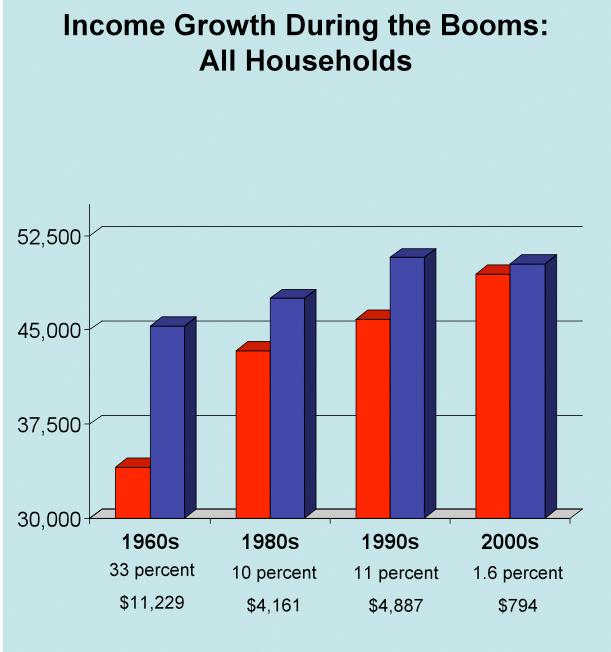
Our Shrinking Economy
When I heard Warren Buffett say, "the pie is always growing," I thought to myself, "your pie is always growing." The middle-class economy has been shrinking for decades. The newspapers only tell us the Dow Jones Average or the S&P 500 or the GDP is increasing.
While running for the local school board in 2010 I ran across this included chart that shows the decline in average disposable income from 33% income to less than 2% over 40 years.
In my campaign I said we need to reduce the emphasis on teaching science and increase emphasis on teaching economics and finance.
Our children who are currently graduating from colleges and universities are having trouble finding jobs. We think it is just a temporary down-turn, but I believe there has also been a steady decline in jobs for the middle-class, a decline that has been going on for decades and has been hushed-up by the papers in the same way the local papers hush-up the decline in Plano schools.
Reliable and Useful Economic Data
The state of Texas needs to accumulate and analyze economic data so we are not dependent on the federal government for economic data and forecasting. After Greenspan let us down, we cannot rely on the Federal Reserve nor on the federal government for economic assessments.
We need data so we can understand what is happening and so we can spot opportunities. We need to be able to devise defensive financial strategies and to spot opportunities for growth.
Foreign Investment
We need data to help us plan investment opportunities for foreign capital to invest in Texas and in our neighboring states. We need data to help us plan capital investment into factories or into export businesses.
Our national economy is a wreck because Wall Street bankers could not or would not find capital investments in American factories for foreign capital. Instead, Wall Street bankers diverted foreign capital into Collateralized Debt Obligations.
If Wall Street bankers will not find good opportunities for foreign investors, then Texans must do so. For the sake of our children's future and the future of the world economy, Texans must do a better job creating good investment opportunities that lead to job creation in Texas.
If Texans fail to develop good investments, then eventually no one in international banking will want U.S. dollars, the dollar will plunge in value, and we will all be ruined. But if we succeed, then Texas will drive the American economy and our children, as well as the whole nation, will prosper.
Robert Canright
Subscribe to:
Posts (Atom)
